
How to Fit Shapes
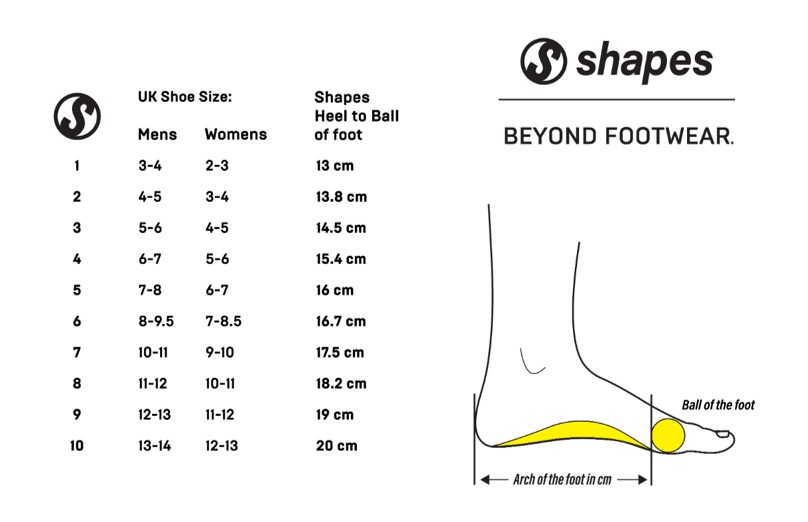
Shapes work best when they fit your foot precisely, from the back of the heel to just before the ball of the foot.
- Measure Your Foot Length (Most Accurate Method)
- Measure the distance (in cm) from back of your heel to just before the balls of your feet.
- Choose the Shapes size that matches this length.
- If you’re between sizes, always choose the smaller size.
- Smaller fits better and functions correctly — too big will not work.
Explore our range below and choose the Edition that fits your activity best.
- Shoe Size Is Only a Starting Point
UK Shoe Size to Shapes Size converter gives an initial guide, but everyone’s feet are different.
- Your measured length is the most reliable way to get the perfect fit.
- Using the Shapes Size Finder (Print-Out Method).
- Lift your heel off the ground, keeping your toes and the balls of your feet down.
- Slide print-out under foot (follow arrows) until it reaches just before the ball of your foo.
- Lower your heel gently onto the print-out.
- The last size line your foot crosses is your Shapes size.
- If you’re between sizes or unsure, choose the smaller size.
For best accuracy, stick the print-out onto a piece of cardboard — it stays flat and prevents sliding too far under the forefoot.
A precise fit makes a huge difference — taking a moment to size correctly ensures Shapes work at their best.
How to Get Used to Shapes
Shapes are a training and activation system that strengthen your foot muscles and support natural alignment through the ankles, knees, and hips.
- Start Slowly
- It’s normal to feel your feet working differently, Shapes activate muscles that often go underused.
- If your foot muscles feel tired or sore, remove Shapes for 1–2 hours to let them relax.
Think back to the first time you tried a new workout — the muscles respond because they’re being trained.
As You Adapt
- Your stabilising muscles will strengthen.
- Your alignment improves through the entire kinetic chain.
Movement becomes more efficient, reducing fatigue and helping you recover quicker
When You’re Fully Used to Shapes
Once your feet and body have adapted to Shapes, you can use them during running, intense training sessions, and sports performance.
Only introduce higher-intensity activities once you are fully comfortable and used to Shapes.
Consistency is key — give your body time to adapt, and Shapes will become a natural part of how you move.